A BELEAGUERED president stubbornly insists on staying the course even as his staunchest allies abandon him. I'm not talking about Iraq, but global warming.
Here's a case where virtually everybody is acknowledging a weapon of mass destruction — the threat of climate chaos — but still President Bush refuses to take action. When the evangelical community, Bush's stalwart base, called for climate action last month, the news grabbed headlines. But the more important Bush defectors on this issue are some of the world's largest corporations, including British Petroleum, General Electric, DuPont and Cinergy. So, the question arises: Why does Bush persist in his increasingly lonely stance?
The answer may lie in the difference between realpolitik and ideology. Many corporations initially opposed climate action as a practical matter, because of its perceived costs. The Bush administration's opposition seems to derive from its ideological hostility to international treaties and the United Nations on the one hand and environmentalists on the other.
One story from 2002 illustrates the different approaches. A former staffer from an anti-climate-action lobbying group, the Global Climate Coalition, had dinner with oil and chemical company bigwigs at the Palm Too restaurant in New York not long after the U.S. negotiating team walked out of the talks on the Kyoto treaty to reduce greenhouse gas emissions.
"You'd think that this group would have been jumping for joy," he told me, "but instead, they were sputtering mad because they felt that the move could not have been done in a more politically incompetent way." The last thing these savvy businessmen wanted was a grand gesture that would galvanize the the world against the U.S. Instead, business groups had hoped for the U.S. to stay inside the negotiations, where they could quietly kill action by a thousand cuts.
That approach had already proved successful. For 17 years, industry-sponsored lobbying groups forestalled action on climate change even as scientific alarm mounted. One prong of the attack was to infiltrate treaty negotiations. The lobbyists not only influenced policy, in some cases they wrote it. In one incident in the 1990s, Don Pearlman, an attorney who represented the Climate Council (another vociferous anti-climate-action group), was escorted from the floor of a Kyoto negotiating session after he was spotted writing positions for the Saudi Arabian delegation.
When they were not writing policy for emerging nations, industry groups were insisting that there was no scientific consensus that climate change was an urgent threat. It was a brilliant tactic. The naysayers didn't have to disprove global warming; they just had to create the impression that it was still subject to debate. This left the public feeling that there was no need to get excited until the scientists sorted things out.
Two things happened to change corporate attitudes. The destructive power of extreme weather events has become impossible to ignore (for instance, Hurricane Katrina and the 2003 heat wave in Europe that killed nearly 35,000 people). Even to the casual observer, the climate system seems to be popping rivets. And multinational corporations couldn't afford to be too out of step with their customers and stakeholders, particularly in the many countries where global warming is viewed as a clear and present danger.
Businesses began defecting from the Global Climate Coalition, which closed up shop in 2002 (noting that the Bush administration had adopted its agenda). And some companies changed positions to attempt green branding or because of the threat of sanctions.
In other cases, however, change came about simply because there was a new boss. That seems to have been the case with General Electric, the ninth-largest corporation in the world. Chief Executive Jack Welch was vocal in his opposition to taking action on climate change, and according to those close to the situation, in 1997 he forced the head of Employers Re, a GE insurance subsidiary, to abandon a plan to join a public/private environmental and climate initiative put together by the U.N. Environment Program. Now, however, under Jeffrey Immelt, GE trumpets the very type of initiatives that Welch squashed.
The changed corporate landscape gives hope until we remember that the climate seems to be changing the landscape that we live on even more rapidly. With carbon dioxide levels already higher than they've been since homo sapiens emerged as a species, we are conducting a science lab experiment on a planetary scale.
India, China and other big greenhouse gas emitters will not do their part unless the United States, the biggest emitter, joins the effort. And that won't happen without presidential leadership. So, President Bush, if the scientific, evangelical and business communities can't sway you, what will it take to persuade you to help halt our lunatic meddling with Earth's atmosphere?
Eugene Linden
Tuesday, March 14, 2006


Wednesday, February 01, 2006
Shots at Canadian envoys first of new war
Now that the war is winding down in Iraq [ROFL], Bush will need another invasion to maintain his popularity (and to keep our troops overseas so they will not be wandering with the hundreds of thousands of other unemployed across our own countryside). The shots at Candian envoys yesterday are the first of many to come.
Here are the top ten reasons for Bush to invade Canada:
10. Won't use much oil--can be done on bicycles.
9. Give U.S. secure borders.
8. Eliminate potential refuge for draft dodgers, runaway slaves, and other dissidents to-be-named later.
7. Invasion of Mexico impractical as we would then have to pay wetbacks minimum wage.
6. Creates more jobs (at least, while war lasts).
5. Keep media focus from our own decaying domestic economy and infrastructure.
4. Provide natural launching pad for land invasion of Europe.
3. Provide hundreds of thousands of acres of trees, minerals, and unspoiled wilderness Bush can share with his cronies.
2. Stop Canadians bellyaching about acid rain, over fishing by USians, ozone-layer depletion, landmines, and arm sales that are really none of their business.
1. Fewer Canadians killed by friendly fire.
Here are the top ten reasons for Bush to invade Canada:
10. Won't use much oil--can be done on bicycles.
9. Give U.S. secure borders.
8. Eliminate potential refuge for draft dodgers, runaway slaves, and other dissidents to-be-named later.
7. Invasion of Mexico impractical as we would then have to pay wetbacks minimum wage.
6. Creates more jobs (at least, while war lasts).
5. Keep media focus from our own decaying domestic economy and infrastructure.
4. Provide natural launching pad for land invasion of Europe.
3. Provide hundreds of thousands of acres of trees, minerals, and unspoiled wilderness Bush can share with his cronies.
2. Stop Canadians bellyaching about acid rain, over fishing by USians, ozone-layer depletion, landmines, and arm sales that are really none of their business.
1. Fewer Canadians killed by friendly fire.
Tuesday, December 13, 2005


Wednesday, November 23, 2005
Abu Ali ruling provides solution to Bush Administration' problems
Do the rantings of Harry Reid, Barbara Boxer, and, indeed, anyone but your favorite talk show host, bother you? Judge Gerald Lee's ruling in the United States v. Abu Ali provides a solution Simply send anyone who speaks out against the President to Saudi Arabia. There they can be tortured until ready to come to terms with their own mortality, provide a videotaped confession (to anything you like) and agree to love Big Brother.
Monday, November 14, 2005
This isn't the real America
IN RECENT YEARS, I have become increasingly concerned by a host of radical government policies that now threaten many basic principles espoused by all previous administrations, Democratic and Republican.
These include the rudimentary American commitment to peace, economic and social justice, civil liberties, our environment and human rights.
Also endangered are our historic commitments to providing citizens with truthful information, treating dissenting voices and beliefs with respect, state and local autonomy and fiscal responsibility.
At the same time, our political leaders have declared independence from the restraints of international organizations and have disavowed long-standing global agreements — including agreements on nuclear arms, control of biological weapons and the international system of justice.
Instead of our tradition of espousing peace as a national priority unless our security is directly threatened, we have proclaimed a policy of "preemptive war," an unabridged right to attack other nations unilaterally to change an unsavory regime or for other purposes. When there are serious differences with other nations, we brand them as international pariahs and refuse to permit direct discussions to resolve disputes.
Regardless of the costs, there are determined efforts by top U.S. leaders to exert American imperial dominance throughout the world.
These revolutionary policies have been orchestrated by those who believe that our nation's tremendous power and influence should not be internationally constrained. Even with our troops involved in combat and America facing the threat of additional terrorist attacks, our declaration of "You are either with us or against us!" has replaced the forming of alliances based on a clear comprehension of mutual interests, including the threat of terrorism.
Another disturbing realization is that, unlike during other times of national crisis, the burden of conflict is now concentrated exclusively on the few heroic men and women sent back repeatedly to fight in the quagmire of Iraq. The rest of our nation has not been asked to make any sacrifice, and every effort has been made to conceal or minimize public awareness of casualties.
Instead of cherishing our role as the great champion of human rights, we now find civil liberties and personal privacy grossly violated under some extreme provisions of the Patriot Act.
Of even greater concern is that the U.S. has repudiated the Geneva accords and espoused the use of torture in Iraq, Afghanistan and Guantanamo Bay, and secretly through proxy regimes elsewhere with the so-called extraordinary rendition program. It is embarrassing to see the president and vice president insisting that the CIA should be free to perpetrate "cruel, inhumane or degrading treatment or punishment" on people in U.S. custody.
Instead of reducing America's reliance on nuclear weapons and their further proliferation, we have insisted on our right (and that of others) to retain our arsenals, expand them, and therefore abrogate or derogate almost all nuclear arms control agreements negotiated during the last 50 years. We have now become a prime culprit in global nuclear proliferation. America also has abandoned the prohibition of "first use" of nuclear weapons against nonnuclear nations, and is contemplating the previously condemned deployment of weapons in space.
Protection of the environment has fallen by the wayside because of government subservience to political pressure from the oil industry and other powerful lobbying groups. The last five years have brought continued lowering of pollution standards at home and almost universal condemnation of our nation's global environmental policies.
Our government has abandoned fiscal responsibility by unprecedented favors to the rich, while neglecting America's working families. Members of Congress have increased their own pay by $30,000 per year since freezing the minimum wage at $5.15 per hour (the lowest among industrialized nations).
I am extremely concerned by a fundamentalist shift in many houses of worship and in government, as church and state have become increasingly intertwined in ways previously thought unimaginable.
As the world's only superpower, America should be seen as the unswerving champion of peace, freedom and human rights. Our country should be the focal point around which other nations can gather to combat threats to international security and to enhance the quality of our common environment. We should be in the forefront of providing human assistance to people in need.
It is time for the deep and disturbing political divisions within our country to be substantially healed, with Americans united in a common commitment to revive and nourish the historic political and moral values that we have espoused during the last 230 years.
Jimmy Carter
These include the rudimentary American commitment to peace, economic and social justice, civil liberties, our environment and human rights.
Also endangered are our historic commitments to providing citizens with truthful information, treating dissenting voices and beliefs with respect, state and local autonomy and fiscal responsibility.
At the same time, our political leaders have declared independence from the restraints of international organizations and have disavowed long-standing global agreements — including agreements on nuclear arms, control of biological weapons and the international system of justice.
Instead of our tradition of espousing peace as a national priority unless our security is directly threatened, we have proclaimed a policy of "preemptive war," an unabridged right to attack other nations unilaterally to change an unsavory regime or for other purposes. When there are serious differences with other nations, we brand them as international pariahs and refuse to permit direct discussions to resolve disputes.
Regardless of the costs, there are determined efforts by top U.S. leaders to exert American imperial dominance throughout the world.
These revolutionary policies have been orchestrated by those who believe that our nation's tremendous power and influence should not be internationally constrained. Even with our troops involved in combat and America facing the threat of additional terrorist attacks, our declaration of "You are either with us or against us!" has replaced the forming of alliances based on a clear comprehension of mutual interests, including the threat of terrorism.
Another disturbing realization is that, unlike during other times of national crisis, the burden of conflict is now concentrated exclusively on the few heroic men and women sent back repeatedly to fight in the quagmire of Iraq. The rest of our nation has not been asked to make any sacrifice, and every effort has been made to conceal or minimize public awareness of casualties.
Instead of cherishing our role as the great champion of human rights, we now find civil liberties and personal privacy grossly violated under some extreme provisions of the Patriot Act.
Of even greater concern is that the U.S. has repudiated the Geneva accords and espoused the use of torture in Iraq, Afghanistan and Guantanamo Bay, and secretly through proxy regimes elsewhere with the so-called extraordinary rendition program. It is embarrassing to see the president and vice president insisting that the CIA should be free to perpetrate "cruel, inhumane or degrading treatment or punishment" on people in U.S. custody.
Instead of reducing America's reliance on nuclear weapons and their further proliferation, we have insisted on our right (and that of others) to retain our arsenals, expand them, and therefore abrogate or derogate almost all nuclear arms control agreements negotiated during the last 50 years. We have now become a prime culprit in global nuclear proliferation. America also has abandoned the prohibition of "first use" of nuclear weapons against nonnuclear nations, and is contemplating the previously condemned deployment of weapons in space.
Protection of the environment has fallen by the wayside because of government subservience to political pressure from the oil industry and other powerful lobbying groups. The last five years have brought continued lowering of pollution standards at home and almost universal condemnation of our nation's global environmental policies.
Our government has abandoned fiscal responsibility by unprecedented favors to the rich, while neglecting America's working families. Members of Congress have increased their own pay by $30,000 per year since freezing the minimum wage at $5.15 per hour (the lowest among industrialized nations).
I am extremely concerned by a fundamentalist shift in many houses of worship and in government, as church and state have become increasingly intertwined in ways previously thought unimaginable.
As the world's only superpower, America should be seen as the unswerving champion of peace, freedom and human rights. Our country should be the focal point around which other nations can gather to combat threats to international security and to enhance the quality of our common environment. We should be in the forefront of providing human assistance to people in need.
It is time for the deep and disturbing political divisions within our country to be substantially healed, with Americans united in a common commitment to revive and nourish the historic political and moral values that we have espoused during the last 230 years.
Jimmy Carter
Saturday, November 05, 2005
Compulsory pregnancy and the 14th amendment
To compel a woman to bear a child to term is nothing less than involuntary servitude, heretofore prohibited by the 14th amendment. Are we to believe that Supreme Court nominee Alito will work to defang that amendment? This will certainly fit in with the Bush administration's intent to turn more government functions over to the private sector. With the 14th amendment no longer enforceable, the costs of providing assistance to the victims of Hurricane Katrina can be taken over by the willing rich willing to adopt a victim or victims as slaves. Indeed as costs rise, salaries drop, and more and more Americans are forced into bankruptcy, we can return to the halcyon days of indentured servants that graced the first days of our 13 colonies.
Monday, October 24, 2005
Why Nations Go To War--America Too.
Why do nations go to war? I don't mean the top guys. Their reasons are straightforward enough: kickbacks from weapons manufacturers and contractors. Even the most conservative Republican can justify government spending when it’s for a righteous cause like war.
I mean why does the rank and file, the average American, so avidly embrace war? The answer is boredom; war relieves the tedium of our everyday lives.
Absent war, "all the news just repeats itself like some forgotten dream." Which, of course, explains why Bush has recently lost the nation's confidence. This many years after the war's start, we no longer find Iraq amusing.
It's easy to see why 18-20 year olds long for war. Just look at their fathers, stooped and graying, tied to the same lathe, the same computer, the same dumb sales meeting for thirty years and what did it get them. War offers an opportunity, perhaps a once-in-a-lifetime opportunity for a little excitement, a chance to travel, to be part of a winning team.
But why would parents risk their 18-20 year investments? Ever sat in the stands at a football game? Or stood embarassed on the sidelines while the kids played soccer and their parents screamed. War is our chance to scream and yell, to unleash the hatreds we store up each day. (No choice but to store up frustrations when so much of our lives is under the control of others.)
War relieves our tensions and provides us with our one chance to excel, if only vicariously. (So what if there were no weapons of mass destruction. We wanted war and no sacrifice was too great.)
The theory that boredom results in war can survive several independent tests. Take the the born agains, self-righteous, smug, (forced to drink and fornicate under the table, to conceal their shame even from themselves), America's Mid-East crusades provide an acceptable outlet for all that ordinarily would be repugnant to a cheek turning, peace-loving Christ.
War offers the opportunity to do so much that cannot be otherwise justified. High school bullies can keep on bullying, even after graduation. And those that were bullied can now torture others.
As for the intellectuals, the peacenicks, always opposed to righteous causes, so out of step with the rest of us, this theory explains them, too. Intellectuals are like new arrivals at a party, two drinks behind. They find their avocations, if not their jobs, completely fulfilling. They solve equations, find cures, build bridges. They even get off on crosswords and sudoku. They're just not bored enough.
I mean why does the rank and file, the average American, so avidly embrace war? The answer is boredom; war relieves the tedium of our everyday lives.
Absent war, "all the news just repeats itself like some forgotten dream." Which, of course, explains why Bush has recently lost the nation's confidence. This many years after the war's start, we no longer find Iraq amusing.
It's easy to see why 18-20 year olds long for war. Just look at their fathers, stooped and graying, tied to the same lathe, the same computer, the same dumb sales meeting for thirty years and what did it get them. War offers an opportunity, perhaps a once-in-a-lifetime opportunity for a little excitement, a chance to travel, to be part of a winning team.
But why would parents risk their 18-20 year investments? Ever sat in the stands at a football game? Or stood embarassed on the sidelines while the kids played soccer and their parents screamed. War is our chance to scream and yell, to unleash the hatreds we store up each day. (No choice but to store up frustrations when so much of our lives is under the control of others.)
War relieves our tensions and provides us with our one chance to excel, if only vicariously. (So what if there were no weapons of mass destruction. We wanted war and no sacrifice was too great.)
The theory that boredom results in war can survive several independent tests. Take the the born agains, self-righteous, smug, (forced to drink and fornicate under the table, to conceal their shame even from themselves), America's Mid-East crusades provide an acceptable outlet for all that ordinarily would be repugnant to a cheek turning, peace-loving Christ.
War offers the opportunity to do so much that cannot be otherwise justified. High school bullies can keep on bullying, even after graduation. And those that were bullied can now torture others.
As for the intellectuals, the peacenicks, always opposed to righteous causes, so out of step with the rest of us, this theory explains them, too. Intellectuals are like new arrivals at a party, two drinks behind. They find their avocations, if not their jobs, completely fulfilling. They solve equations, find cures, build bridges. They even get off on crosswords and sudoku. They're just not bored enough.
Monday, October 17, 2005
American Debacle By Zbigniew Brzezinski
Some 60 years ago Arnold Toynbee concluded, in his monumental "Study of History," that the ultimate cause of imperial collapse was "suicidal statecraft." Sadly for George W. Bush's place in history and — much more important — ominously for America's future, that adroit phrase increasingly seems applicable to the policies pursued by the United States since the cataclysm of 9/11.
Though there have been some hints that the Bush administration may be beginning to reassess the goals, so far defined largely by slogans, of its unsuccessful military intervention in Iraq, President Bush's speech Thursday was a throwback to the demagogic formulations he employed during the 2004 presidential campaign to justify a war that he himself started.
That war, advocated by a narrow circle of decision-makers for motives still not fully exposed, propagated publicly by rhetoric reliant on false assertions, has turned out to be much more costly in blood and money than anticipated. It has precipitated worldwide criticism. In the Middle East it has stamped the United States as the imperialistic successor to Britain and as a partner of Israel in the military repression of the Arabs. Fair or not, that perception has become widespread throughout the world of Islam.
Now, however, more than a reformulation of U.S. goals in Iraq is needed. The persistent reluctance of the administration to confront the political background of the terrorist menace has reinforced sympathy among Muslims for the terrorists. It is a self-delusion for Americans to be told that the terrorists are motivated mainly by an abstract "hatred of freedom" and that their acts are a reflection of a profound cultural hostility. If that were so, Stockholm or Rio de Janeiro would be as much at risk as New York City. Yet, in addition to New Yorkers, the principal victims of serious terrorist attacks have been Australians in Bali, Spaniards in Madrid, Israelis in Tel Aviv, Egyptians in the Sinai and Britons in London.
There is an obvious political thread connecting these events: The targets are America's allies and client states in its deepening military intervention in the Middle East. Terrorists are not born but shaped by events, experiences, impressions, hatreds, ethnic myths, historical memories, religious fanaticism and deliberate brainwashing. They are also shaped by images of what they see on television, and especially by feelings of outrage at what they perceive to be the brutal denigration of their religious kin's dignity by heavily armed foreigners. An intense political hatred for America, Britain and Israel is drawing recruits for terrorism not only from the Middle East but as far away as Ethiopia, Morocco, Pakistan, Indonesia and even the Caribbean.
America's ability to cope with nuclear nonproliferation has also suffered. The contrast between the attack on the militarily weak Iraq and America's forbearance of a nuclear-armed North Korea has strengthened the conviction of the Iranians that their security can only be enhanced by nuclear weapons. Moreover, the recent U.S. decision to assist India's nuclear program, driven largely by the desire for India's support for the war in Iraq and as a hedge against China, has made the U.S. look like a selective promoter of nuclear weapons proliferation. This double standard will complicate the quest for a constructive resolution of the Iranian nuclear problem.
Compounding such political dilemmas is the degradation of America's moral standing in the world. The country that has for decades stood tall in opposition to political repression, torture and other violations of human rights has been exposed as sanctioning practices that hardly qualify as respect for human dignity. Even more reprehensible is the fact that the shameful abuse and/or torture in Guantanamo and Abu Ghraib was exposed not by an outraged administration but by the U.S. media. In response, the administration confined itself to punishing a few low-level perpetrators; none of the top civilian and military decision-makers in the Department of Defense and on the National Security Council who sanctioned "stress interrogations" (a.k.a. torture) were publicly disgraced, prosecuted or forced to resign. The administration's opposition to the International Criminal Court now seems quite self-serving.
Finally, complicating this sorry foreign policy record are war-related economic trends. The budgets for the departments of Defense and Homeland Security are now larger than the total budget of any nation, and they are likely to continue escalating as budget and trade deficits transform America into the world's No. 1 debtor nation. At the same time, the direct and indirect costs of the war in Iraq are mounting, even beyond the pessimistic prognoses of its early opponents, making a mockery of the administration's initial predictions. Every dollar so committed is a dollar not spent on investment, on scientific innovation or on education, all fundamentally relevant to America's long-term economic primacy in a highly competitive world.
It should be a source of special concern for thoughtful Americans that even nations known for their traditional affection for America have become openly critical of U.S. policy. As a result, large swathes of the world — including nations in East Asia, Europe and Latin America — have been quietly exploring ways of shaping regional associations tied less to the notions of transpacific, or transatlantic, or hemispheric cooperation with the United States. Geopolitical alienation from America could become a lasting and menacing reality.
That trend would especially benefit America's historic ill-wishers and future rivals. Sitting on the sidelines and sneering at America's ineptitude are Russia and China — Russia, because it is delighted to see Muslim hostility diverted from itself toward America, despite its own crimes in Afghanistan and Chechnya, and is eager to entice America into an anti-Islamic alliance; China, because it patiently follows the advice of its ancient strategic guru, Sun Tzu, who taught that the best way to win is to let your rival defeat himself.
In a very real sense, during the last four years the Bush team has dangerously undercut America's seemingly secure perch on top of the global totem pole by transforming a manageable, though serious, challenge largely of regional origin into an international debacle. Because America is extraordinarily powerful and rich, it can afford, for a while longer, a policy articulated with rhetorical excess and pursued with historical blindness. But in the process, America is likely to become isolated in a hostile world, increasingly vulnerable to terrorist acts and less and less able to exercise constructive global influence. Flailing away with a stick at a hornets' nest while loudly proclaiming "I will stay the course" is an exercise in catastrophic leadership.
But it need not be so. A real course correction is still possible, and it could start soon with a modest and common-sense initiative by the president to engage the Democratic congressional leadership in a serious effort to shape a bipartisan foreign policy for an increasingly divided and troubled nation. In a bipartisan setting, it would be easier not only to scale down the definition of success in Iraq but actually to get out — perhaps even as early as next year. And the sooner the U.S. leaves, the sooner the Shiites, Kurds and Sunnis will either reach a political arrangement on their own or some combination of them will forcibly prevail.
With a foreign policy based on bipartisanship and with Iraq behind us, it would also be easier to shape a wider Middle East policy that constructively focuses on Iran and on the Israeli-Palestinian peace process while restoring the legitimacy of America's global role.
Though there have been some hints that the Bush administration may be beginning to reassess the goals, so far defined largely by slogans, of its unsuccessful military intervention in Iraq, President Bush's speech Thursday was a throwback to the demagogic formulations he employed during the 2004 presidential campaign to justify a war that he himself started.
That war, advocated by a narrow circle of decision-makers for motives still not fully exposed, propagated publicly by rhetoric reliant on false assertions, has turned out to be much more costly in blood and money than anticipated. It has precipitated worldwide criticism. In the Middle East it has stamped the United States as the imperialistic successor to Britain and as a partner of Israel in the military repression of the Arabs. Fair or not, that perception has become widespread throughout the world of Islam.
Now, however, more than a reformulation of U.S. goals in Iraq is needed. The persistent reluctance of the administration to confront the political background of the terrorist menace has reinforced sympathy among Muslims for the terrorists. It is a self-delusion for Americans to be told that the terrorists are motivated mainly by an abstract "hatred of freedom" and that their acts are a reflection of a profound cultural hostility. If that were so, Stockholm or Rio de Janeiro would be as much at risk as New York City. Yet, in addition to New Yorkers, the principal victims of serious terrorist attacks have been Australians in Bali, Spaniards in Madrid, Israelis in Tel Aviv, Egyptians in the Sinai and Britons in London.
There is an obvious political thread connecting these events: The targets are America's allies and client states in its deepening military intervention in the Middle East. Terrorists are not born but shaped by events, experiences, impressions, hatreds, ethnic myths, historical memories, religious fanaticism and deliberate brainwashing. They are also shaped by images of what they see on television, and especially by feelings of outrage at what they perceive to be the brutal denigration of their religious kin's dignity by heavily armed foreigners. An intense political hatred for America, Britain and Israel is drawing recruits for terrorism not only from the Middle East but as far away as Ethiopia, Morocco, Pakistan, Indonesia and even the Caribbean.
America's ability to cope with nuclear nonproliferation has also suffered. The contrast between the attack on the militarily weak Iraq and America's forbearance of a nuclear-armed North Korea has strengthened the conviction of the Iranians that their security can only be enhanced by nuclear weapons. Moreover, the recent U.S. decision to assist India's nuclear program, driven largely by the desire for India's support for the war in Iraq and as a hedge against China, has made the U.S. look like a selective promoter of nuclear weapons proliferation. This double standard will complicate the quest for a constructive resolution of the Iranian nuclear problem.
Compounding such political dilemmas is the degradation of America's moral standing in the world. The country that has for decades stood tall in opposition to political repression, torture and other violations of human rights has been exposed as sanctioning practices that hardly qualify as respect for human dignity. Even more reprehensible is the fact that the shameful abuse and/or torture in Guantanamo and Abu Ghraib was exposed not by an outraged administration but by the U.S. media. In response, the administration confined itself to punishing a few low-level perpetrators; none of the top civilian and military decision-makers in the Department of Defense and on the National Security Council who sanctioned "stress interrogations" (a.k.a. torture) were publicly disgraced, prosecuted or forced to resign. The administration's opposition to the International Criminal Court now seems quite self-serving.
Finally, complicating this sorry foreign policy record are war-related economic trends. The budgets for the departments of Defense and Homeland Security are now larger than the total budget of any nation, and they are likely to continue escalating as budget and trade deficits transform America into the world's No. 1 debtor nation. At the same time, the direct and indirect costs of the war in Iraq are mounting, even beyond the pessimistic prognoses of its early opponents, making a mockery of the administration's initial predictions. Every dollar so committed is a dollar not spent on investment, on scientific innovation or on education, all fundamentally relevant to America's long-term economic primacy in a highly competitive world.
It should be a source of special concern for thoughtful Americans that even nations known for their traditional affection for America have become openly critical of U.S. policy. As a result, large swathes of the world — including nations in East Asia, Europe and Latin America — have been quietly exploring ways of shaping regional associations tied less to the notions of transpacific, or transatlantic, or hemispheric cooperation with the United States. Geopolitical alienation from America could become a lasting and menacing reality.
That trend would especially benefit America's historic ill-wishers and future rivals. Sitting on the sidelines and sneering at America's ineptitude are Russia and China — Russia, because it is delighted to see Muslim hostility diverted from itself toward America, despite its own crimes in Afghanistan and Chechnya, and is eager to entice America into an anti-Islamic alliance; China, because it patiently follows the advice of its ancient strategic guru, Sun Tzu, who taught that the best way to win is to let your rival defeat himself.
In a very real sense, during the last four years the Bush team has dangerously undercut America's seemingly secure perch on top of the global totem pole by transforming a manageable, though serious, challenge largely of regional origin into an international debacle. Because America is extraordinarily powerful and rich, it can afford, for a while longer, a policy articulated with rhetorical excess and pursued with historical blindness. But in the process, America is likely to become isolated in a hostile world, increasingly vulnerable to terrorist acts and less and less able to exercise constructive global influence. Flailing away with a stick at a hornets' nest while loudly proclaiming "I will stay the course" is an exercise in catastrophic leadership.
But it need not be so. A real course correction is still possible, and it could start soon with a modest and common-sense initiative by the president to engage the Democratic congressional leadership in a serious effort to shape a bipartisan foreign policy for an increasingly divided and troubled nation. In a bipartisan setting, it would be easier not only to scale down the definition of success in Iraq but actually to get out — perhaps even as early as next year. And the sooner the U.S. leaves, the sooner the Shiites, Kurds and Sunnis will either reach a political arrangement on their own or some combination of them will forcibly prevail.
With a foreign policy based on bipartisanship and with Iraq behind us, it would also be easier to shape a wider Middle East policy that constructively focuses on Iran and on the Israeli-Palestinian peace process while restoring the legitimacy of America's global role.
Friday, October 07, 2005
Get Out of Iraq
Is there anybody here who'd like to change his clothes into a uniform?
Is there anybody here that thinks they're only serving on a raging storm?
Is there anybody here, glory in his eye, loyal to the end, whose duty is to die?
I want to see him
I want to wish him luck
I want to shake his hand
I want to call his name
Pin a medal on a man
Is there anybody here who'd like to wrap a flag around an early grave?
Is there anybody here who thinks they stand taller on a battle wave?
Is there anybody here who'd like to do his part, soldier to the world, and a bullet to the heart?
I want to see him
I want to wish him luck
I want to shake his hand
I want to call his name
Pin a medal on a man
Is there anybody here so proud of the parade,
Who'd like to give a cheer to show they're not afraid?
I'd like to ask him what he's trying to defend;
I'd like to ask him what he think's he's going to win.
I want to see him
I want to wish him luck
I want to shake his hand
I want to call his name
Pin a medal on the man
Is there anybody here who thinks that following the orders takes away the blame?
Is there anybody here who wouldn't mind a murder by another name?
Is there anybody whose pride is on the line, with the honor of the brave and the courage of the blind?
I want to see him
I want to wish him luck
I want to shake his hand
I want to call his name
Pin a medal on the man
Phil Ochs
Is there anybody here that thinks they're only serving on a raging storm?
Is there anybody here, glory in his eye, loyal to the end, whose duty is to die?
I want to see him
I want to wish him luck
I want to shake his hand
I want to call his name
Pin a medal on a man
Is there anybody here who'd like to wrap a flag around an early grave?
Is there anybody here who thinks they stand taller on a battle wave?
Is there anybody here who'd like to do his part, soldier to the world, and a bullet to the heart?
I want to see him
I want to wish him luck
I want to shake his hand
I want to call his name
Pin a medal on a man
Is there anybody here so proud of the parade,
Who'd like to give a cheer to show they're not afraid?
I'd like to ask him what he's trying to defend;
I'd like to ask him what he think's he's going to win.
I want to see him
I want to wish him luck
I want to shake his hand
I want to call his name
Pin a medal on the man
Is there anybody here who thinks that following the orders takes away the blame?
Is there anybody here who wouldn't mind a murder by another name?
Is there anybody whose pride is on the line, with the honor of the brave and the courage of the blind?
I want to see him
I want to wish him luck
I want to shake his hand
I want to call his name
Pin a medal on the man
Phil Ochs
Monday, September 19, 2005
Calling the Democrats on their courage
Some would cast the Democrats as cowards at the poker table of politics. This is the conventional analysis, but I am afraid it does not accord with the facts. As an example, in the case of the war on Iraq, fully 60% of the American people want the U.S. to pull out some or all of the troops. That is one heck of a base on which to build a movement and a party. And yet the Dems, in the person of John Kerry, Howard Dean, Hillary Clinton and others, are calling for "staying the course" and even sending more troops.
This cannot be accounted for by "cowardice" but rather by the fact that the Dems are beholden to the same special interests as the Republicans: the oil tycoons, the barons of the military-industrial complex and those that thrive on empire, from the major banks to Bechtel and Halliburton. Take, for example, Sen. Dianne Feinstein, who is for "staying the course." Antiwar sentiment is solid in California, yet she refuses to embrace it even though it would strengthen, not weaken, her. No, the Democrats are simply the other war party. And in defying their constituencies that are overwhelmingly antiwar, they are in fact quite courageous.
JOHN V. WALSH
This cannot be accounted for by "cowardice" but rather by the fact that the Dems are beholden to the same special interests as the Republicans: the oil tycoons, the barons of the military-industrial complex and those that thrive on empire, from the major banks to Bechtel and Halliburton. Take, for example, Sen. Dianne Feinstein, who is for "staying the course." Antiwar sentiment is solid in California, yet she refuses to embrace it even though it would strengthen, not weaken, her. No, the Democrats are simply the other war party. And in defying their constituencies that are overwhelmingly antiwar, they are in fact quite courageous.
JOHN V. WALSH
Friday, September 09, 2005
Help for Rehnquist's daughter
Can someone please be on the lookout for a job for Rehnquist's daughter? She was appointed by Bush to a managerial post in government for which she was supremely unqualified following Rehnquist's favorable vote in State of Florida vs. Bush. Word on the street has it that Bush is going to dump her now that her dad can't do anything more for him.
Monday, September 05, 2005
Little Hitlers
Lifeboats left the Titanic half-empty, as little Hitlers in the form of ship's personnel actively prevented passengers from access to lifeboats. The same scene of horror is being repeated today as Federal officials actively bar rescue to New Orleans flood victims. You can listen to reports from the scene (see Horror Show at http://www.crooksandliars.com/2005/09/02.html#a4763) . Here is a statement fromJefferson Parish President, On Timmeh (Jeffersonis ajacent to Orleans Parish):
Sir, they were told like me. Every single day. The cavalry is coming. On the federal level. The cavalry is coming. The cavalry is coming. The cavalry is coming. I have just begun to hear the hooves of the cavalry. The cavalry is still not here yet, but I have begun to hear the hooves and we're almost a week out.
Three quick examples. We had Wal-mart deliver three trucks of water. Trailer trucks of water. FEMA turned them back, said we didn't need them. This was a week go. We had 1,000 gallons of diesel fuel on a coast guard vessel docked in my parish. The coast guard said come get the fuel right way. When we got there with our trucks, they got a word, FEMA says don't give you the fuel. Yesterday, yesterday, FEMA comes in and cuts all our emergency communications lines. They cut them without notice. Our sheriff, Harry Lee, goes back in. he reconnects the line. He posts armed guards said no one is getting near these lines.
...
The guy who runs this building I'm in. Emergency management. He's responsible for everything. His mother was trapped in a St. Bernard nursing home and every day she called him and said, "Are you coming. Son? Is somebody coming? "And he said yeah. Mama. Somebody's coming to get you.. Somebody's coming to get you on Tuesday. Somebody's coming to get you on Wednesday. Somebody's coming to get you on Thursday. Somebody's coming to get you on Friday. And she drowned Friday night. And she drowned Friday night. Nobody's coming to get us. Nobody's coming to get us. The Secretary has promised. Everybody's promised. They've had press conferences. I'm sick of the press conferences. For god's sakes, just shut up and send us somebody.
Sunday, September 04, 2005
Eyewitness in New Orleans
Walking among exhausted, shocked and worried refugees, many of whom have lost everything, I got my first close-up look at the devastating impact of Katrina. In this grim and teeming way station, the nation's incomprehensibly slow-footed rescue effort struck me as all the more staggering.
In a major city in the United States of America, it took days for food and medical supplies to be delivered, for guard troops to be brought in and for sick and elderly people to be rescued from rooftops.
Bodies lay in streets, floated in rivers, piled up at morgues in the Gulf states, and nobody seemed to know who was in charge of rescue efforts.
As lives hung in the balance, House Speaker J. Dennis Hastert all but suggested that New Orleans should be bulldozed because of its precarious geography.
The head of the Federal Emergency Management Agency said Thursday on national radio that he was unaware of the chaos and suffering at the sweltering convention center, where thousands lived in unspeakable filth.
All of this is somewhat less surprising when you consider that it was the president who set the tone for so casual a response to death, a president more intent on saving face in Iraq than saving lives in the United States.
President Bush, who last year slashed an Army Corps of Engineers request for flood protection in New Orleans, waited four days to visit one of the deadliest disasters in American history.
When Bush finally arrived in the city where levees could have been bolstered with a few weeks' worth of the cost of the war in Iraq, he told the nation he'd had lots of fun in New Orleans in his day. He said he was satisfied with the hurricane response but not the results — decipher if you can — and then he boarded Air Force One and flew home without visiting the sick and suffering at an airport triage center.
Why the quick exit? There is work to be done back in Washington, where the agenda includes another round of tax cuts for the wealthiest Americans and gigantic cuts in benefits to the poor, many of whom we saw in the black neighborhoods of New Orleans for several days running, clinging to life and waiting for someone to throw them a line.
Steve Lopez
In a major city in the United States of America, it took days for food and medical supplies to be delivered, for guard troops to be brought in and for sick and elderly people to be rescued from rooftops.
Bodies lay in streets, floated in rivers, piled up at morgues in the Gulf states, and nobody seemed to know who was in charge of rescue efforts.
As lives hung in the balance, House Speaker J. Dennis Hastert all but suggested that New Orleans should be bulldozed because of its precarious geography.
The head of the Federal Emergency Management Agency said Thursday on national radio that he was unaware of the chaos and suffering at the sweltering convention center, where thousands lived in unspeakable filth.
All of this is somewhat less surprising when you consider that it was the president who set the tone for so casual a response to death, a president more intent on saving face in Iraq than saving lives in the United States.
President Bush, who last year slashed an Army Corps of Engineers request for flood protection in New Orleans, waited four days to visit one of the deadliest disasters in American history.
When Bush finally arrived in the city where levees could have been bolstered with a few weeks' worth of the cost of the war in Iraq, he told the nation he'd had lots of fun in New Orleans in his day. He said he was satisfied with the hurricane response but not the results — decipher if you can — and then he boarded Air Force One and flew home without visiting the sick and suffering at an airport triage center.
Why the quick exit? There is work to be done back in Washington, where the agenda includes another round of tax cuts for the wealthiest Americans and gigantic cuts in benefits to the poor, many of whom we saw in the black neighborhoods of New Orleans for several days running, clinging to life and waiting for someone to throw them a line.
Steve Lopez
Saturday, September 03, 2005
Don’t Blame Bush
Don’t blame Bush for the tardy and inadequate response of Federal authorities to Hurricane Katrina. In contrast to the 9/11 terrorist attack for which Bush had several months of advance warning, Katrina came as a total surprise, more so, as in contrast to most Texas ranchers, Bush has little or no interest in the weather.
While Bush's response is often unfavorably compared with his actions following 9/11, he was as inadequate then as now. A promise to confiscate the funds of those who’d financed the terrorists was abandoned once Bush learned the monies came from his campaign backers in Saudi Arabia. Similarly, though the lack of a central computer kept authorities from tracking the activities of the terrorists as they moved freely about the country, the INS (now a minor branch of Homeland Security) still lacks that computer today.Friday, September 02, 2005
Let’s Tax (wisely) and Spend (wisely)
Our nation, already on the brink of bankruptcy as a result of our engagement in unnecesary foreign wars has been pushed over the edge by foreseeable, but unplanned for natural disasters. New Orleans was built below water level, over-built California is perched atop large-scale faults in the earth, and much of the Midwest lies along tornado alleys created by the Interstate Highway System.
We need to tax wisely and spend wisely. The first source of tax revenue for the States should be gasoline taxes. Every freshman economics student knows the theory of supply and demand. Raise the price and demand drops. Alas, the supply and demand curve for gasoline is relatively inelastic. The price of gasoline can be raised again and again without demand being affected. But there is a limiting price at which consumers will, finally, begin to balk. Oil companies have raised their prices again and again searching for that limit. To date, all the profits have gone to the oil companies. By adding a dollar or more in tax to each gallon of gasoline, we will arrive at that limit sooner than expected, with the happy result that all the profits along the way will go back to us the taxpayers.
The second major source of revenue will be estate taxes. This country was founded two hundred plus years ago on the theory that inherited wealth didn’t mean diddlysquat, that the right to the pursuit of happiness would be open to all regardless of birth. Acting within our democratic principles, the States should impose a tax of 50% on all estates in excess of $2 million and of 90% on all estates in excess of $5 million. Bill Gates is entitled to all the results of his hard work and good judgment; his kid isn’t.
The Soviet Union fell apart when it became evident that the sons and daughters of its dedicated if ruthless leaders had no taste for work (though plenty for cocaine and fast cars). Don’t let this happen here.
The third source of revenue is based on a proposal by Abraham Lincoln when he found himself engaged in a war he did not want. Let those who profit most from a country be the ones to pay to preserve it. And the President asked Congress to impose a graduated income tax. Let him do so once again.
The rich will flee the country will they? Right. Just as earth quakes and mudslides have forced so many executives to move from California.
Which reminds me. Let a dollar-for-dollar assessment be levied against any and all attempts by American residents to make deposits in offshore accounts. Let a two-dollar per dollar assessment be made against any American business that raises prices during a natural catastrophe. Let a 90% tax be levied on all profits from sales to the Department of Defense or its contractors.
Now, how do we spend this revenue?
1. Rescue efforts.
2. Housing for the homeless and those without funds.
3. Rebuilding water supplies and sewage lines nationwide. The allocation of monies thereof to be determined on the basis of population, made locally by individual Congressmen, and audited by the General Accounting Office.
4. To local police departments for training and additional personnel.
5. For education to replace the monies slashed by “The No-Child Left Behind” Act.
6. To hire meat and agricultural product inspectors.
7. On computer equipment for the immigration and naturalization service so they may track visitors, temporary residents, and potential terrorists.
8. On increased personnel for the border patrol so they may prevent illegal immigration.
9. On increased personnel for the immigration and naturalization service so they may track down and deport illegal immigrants who’ve made it past the border patrol. (This could include the payment of bounties to local police departments for turning over illegals to the INS.)
Bring home troops to repair flood damage
Let's bring our troops home from Iraq and put them to work on Domestic Oil production. To get Republicans behind this, all cost to be borne as before by American tax payers, and all profits to go to Oil Companies.
Thursday, September 01, 2005
Congratulations George W
Under former Governor Bush, the proportion of Americans living in poverty has risen almost to the level reached under the previous Bush administration, while the proportion without medical insurance has acheived an all-time high of 45.8% By cutting the funds available for education, George has made certain that any reduction in these levels will be extremely unlikely. Also, on the plus side, record profits have been made from Bush's war as witnessed by dramatic increases in bank deposits in Switzerland and the Cayman Islands.
What would you say if you met face to face with President Bush?
4 out of 10 would ask the President to get out of Iraq, 3 out of 10 would ask him to bring the war to an end by sending more troups, and 30% would ask for a federal ban on pre-empting soaps during prime time.
Friday, August 19, 2005
Theory of Intelligent Design
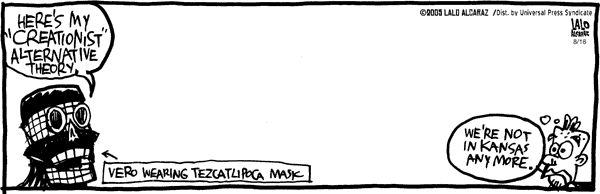 Actually, like Telliard de Chardin, I've always found evolution to be one of the proofs of the existence of God. Imagine, across the galaxies, billions of life forms are evolving as their environments come into being.
Subscribe to:
Posts (Atom)